Expert Surgical Services for Your Pet
In our continuing efforts to offer the highest quality veterinary medicine, we are pleased to provide a wide range of surgical services for our patients, including CO2 laser surgery. From routine surgical procedures, such as spaying and neutering, to more complex surgeries, we look forward to the opportunity to care for your pet’s surgical needs.
Book Online

Spay and Neuter
One of the main reasons for spaying and neutering your pets is to control the pet population. Every year, millions of cats and dogs end up in shelters, and many of them are euthanized due to overpopulation. By spaying and neutering your pets, you're preventing unwanted litters and helping to reduce the number of animals in shelters.
Spaying and neutering also have numerous health benefits for your pet. For female pets, spaying eliminates the risk of uterine infections and reduces the risk of breast cancer. For male pets, neutering eliminates the risk of testicular cancer and reduces the risk of prostate problems. These procedures can also help reduce behavioral issues such as aggression and roaming.
Loving Care Animal Hospital has a team of experienced and skilled surgeons who specialize in spay and neuter surgeries. They have performed thousands of these procedures and are well-equipped to handle any complications that may arise.
Soft Tissue Surgery
Soft tissue surgery is a type of pet surgery that involves operating on tissues that are not related to bones or joints. This can include organs, muscles, and other tissues in the body. Some common examples of soft tissue surgery in pets include tumor removal and gastrointestinal procedures.
Mass Removal
Veterinary mass removal, also known as mass excision, is a surgical procedure that involves removing a mass or tumor from your pet's body. These masses can be either benign (non-cancerous) or malignant (cancerous). The surgery can be done on both dogs and cats.
Mass removal surgery may be necessary for a variety of reasons. Some common reasons include:
- The mass is causing discomfort or pain for your pet
- The mass is interfering with your pet's daily activities (e.g. walking, eating)
- The mass is growing rapidly
- The mass is suspected to be cancerous
- The mass is causing an infection or other health issues
Gastrointestinal Procedures
Gastrointestinal procedures deal with your pet’s digestive system and related organs. These often include surgeries to remove foreign bodies that your pet has swallowed from their stomach. As with all surgical procedures, we only advise gastrointestinal procedures when your pet’s health and safety are at risk and there are no non-invasive options that could prove effective.
Splenectomy Surgery
A splenectomy surgery is the removal of the spleen, a large organ located in the abdomen that plays a vital role in the immune system and blood filtration. The spleen can become enlarged due to various conditions, such as tumors, infections, or trauma, and may need to be removed to prevent further complications.
There are several reasons why a splenectomy may be necessary for your pet. The most common reason is the presence of a splenic tumor, which can be either benign or malignant. These tumors can cause the spleen to become enlarged, leading to discomfort, pain, and potential rupture.
Other conditions that may require a splenectomy include:
- Splenic torsion: A condition where the spleen twists on itself, cutting off blood supply and causing severe pain and potential rupture.
- Splenic hematoma: A collection of blood within the spleen, which can cause the organ to become enlarged and potentially rupture.
- Splenic abscess: An infection within the spleen that can cause severe pain and discomfort.
- Immune-mediated hemolytic anemia (IMHA): A condition where the immune system attacks and destroys red blood cells, leading to an enlarged spleen and potential rupture.
In all of these cases, a splenectomy is necessary to remove the affected spleen and prevent further complications.
Laser Surgery
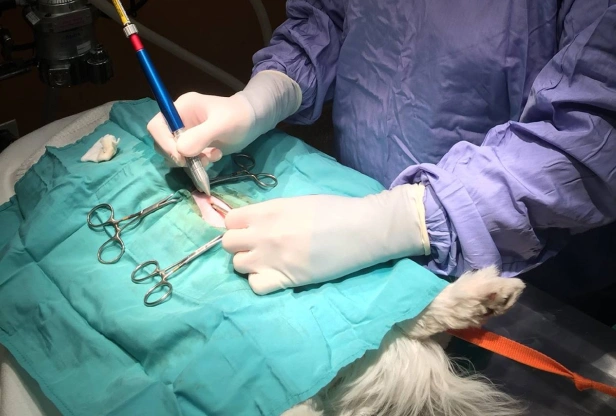
There are many benefits to using the CO2 laser during surgery. Patients have reduced bleeding, less pain, less swelling at the surgical site, reduced risk of infection, and quicker recovery time.
Our staff is highly skilled in performing surgeries and will make every effort to ensure your pet receives the best care. We focus on patient safety, pain management, and employing the most current surgical practices. Our staff of compassionate, caring professionals will monitor your pet before, during, and after surgery and will take exceptional care to ensure a safe and complete recovery. We will also address any questions or concerns you may have about the surgery, anesthesia, pain management, or postoperative care.
When your pet is ready to go home, we will review your postoperative care and medication instructions. If any questions arise after your pet returns home or at any other time during the postoperative period, call us. We welcome your questions and will do all we can to help your pet recover fully. Help is only a phone call away.
Surgery can be a source of anxiety and stress for many pet owners. Maybe you worry about whether your pet will be well cared for, or perhaps you have concerns about adequate precautions and monitoring. Let us address your concerns. Whether your pet needs minor surgery or a complex procedure, let’s discuss how our surgical services can benefit your pet.
Unable to locate Global Block : 69